
Artificial intelligence is everywhere. It seems like almost every product, from software applications to everyday household devices, is getting an AI upgrade.
At the same time, AI is evolving so quickly that even people who work in technology can struggle to keep up with the latest developments.
To make things easier, let’s explore seven important AI terms, explain what they mean in simple language, and look at how they work in the real world.
1. Agentic AI: AI That Can Take Action
You’ve probably heard a lot about AI agents recently. But what exactly makes an AI agent different from a regular chatbot?
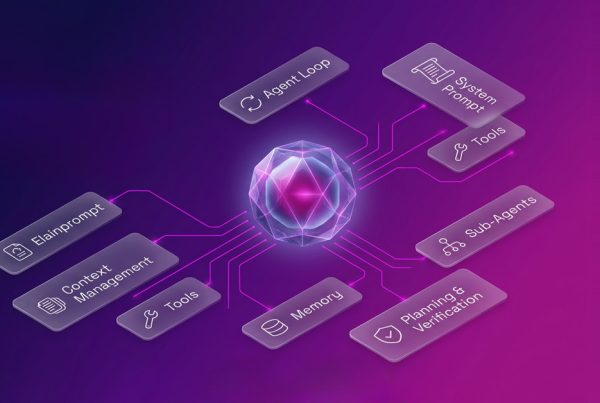
A traditional chatbot typically responds to your questions one at a time. An AI agent, on the other hand, can work toward a goal by planning tasks, taking actions, and adjusting its approach based on the results.
Think of an AI agent as a digital assistant that doesn’t just tell you what to do. It can also help you get things done.
Most AI agents follow a cycle:
- Observe: Understand the current situation and gather relevant information.
- Reason: Decide what needs to happen next.
- Act: Perform an action based on its plan.
- Evaluate: Check the results and decide whether another action is necessary.
The agent repeats this cycle until it reaches its goal or determines that it needs additional information or human approval.
For example, a travel agent powered by AI could research destinations, compare flights, find suitable hotels, and prepare an itinerary. With the right tools and permissions, it might even complete bookings.
AI agents can also help businesses analyze reports, identify unusual activity in system logs, test software fixes, and automate routine operational tasks.
Of course, their capabilities depend on the tools they can access, the permissions they have, and how reliably they perform.
Why it matters: AI is moving beyond simply generating answers toward completing entire workflows. This makes AI agents particularly useful for tasks that involve multiple steps, decisions, and tools.
2. Large Reasoning Models: AI That Works Through Complex Problems
AI agents often need to solve problems that involve several steps. This is where large reasoning models come in.
A large reasoning model is an AI model designed or trained to perform better on complex reasoning tasks, such as mathematics, programming, and logical problem-solving.
Unlike a system optimized mainly for quick responses, a reasoning model may spend additional computation working through a problem before producing its final answer.
For example, imagine asking an AI to investigate why a software application keeps crashing.
Instead of immediately suggesting a random solution, a reasoning-focused model might examine the available evidence, identify possible causes, compare different explanations, and work toward a more reliable answer.
These models can be trained using techniques such as supervised fine-tuning and reinforcement learning. In some cases, training includes problems with answers that can be objectively verified, such as mathematical exercises or code that can be tested.
You may have noticed that some AI chatbots display a message such as “Thinking” before responding. This can indicate that the system is performing additional reasoning computations.
However, the internal process is more complicated than a simple human-style thought process, and the displayed explanation may not reveal every internal computation.
Why it matters: Reasoning models can be particularly valuable when an AI system needs to plan, analyze evidence, solve difficult problems, or coordinate a sequence of actions.
Combined with appropriate tools, they can make AI agents more capable of handling complex tasks.
3. Vector Databases: Finding Information by Meaning
Traditional databases are good at storing and retrieving structured information. But what if you want to search for information based on its meaning rather than an exact keyword?
This is where vector databases become useful.
To understand how they work, you first need to understand something called an embedding.
An embedding model converts information, such as text, images, or audio, into a numerical representation called a vector. A vector is essentially a list of numbers that captures certain features of the original information.
These numbers allow a computer to compare pieces of information mathematically.
For example, imagine you have thousands of photographs and want to find pictures similar to a particular mountain landscape.
A conventional keyword search might struggle if the photographs have no useful descriptions or tags.
With an embedding model, the images can be converted into vectors. A vector database can then help find images whose vectors are close to the vector of your example photograph.
The same approach can be used with text documents, product descriptions, music, and other types of content, provided suitable embedding models are available.
Semantic similarity isn’t exactly the same as identical meaning, though. Results depend on the embedding model, the type of content, and the search method being used.
Why it matters: Vector databases make it easier for AI applications to search large collections of information based on similarity and context, even when the original content doesn’t contain the exact words used in a search.
4. RAG: Giving AI Access to Relevant Information
Large language models can answer many questions, but they don’t automatically know everything about your company, your private documents, or the latest information in your systems.
They can also produce incorrect answers when they lack the information needed to respond accurately.
Retrieval-Augmented Generation, or RAG, helps address this problem by retrieving relevant information and providing it to an AI model when it generates a response.
Here’s how a typical RAG system works:
- You ask a question. For example, “How many vacation days do employees receive?”
- The system searches relevant information. It might look through company policies, an employee handbook, or internal documentation.
- It retrieves useful passages. A vector database may help find sections related to the question, often using semantic similarity.
- The retrieved information is added to the prompt. The AI receives both your question and the relevant material.
- The AI generates an answer. It uses the supplied information to produce a response.
For instance, instead of relying on its general training to answer a question about your company’s vacation policy, the AI can refer to the relevant section of the actual employee handbook.
RAG systems don’t always require vector databases. They can also use keyword search, traditional databases, or a combination of retrieval techniques.
And although RAG can improve accuracy, it doesn’t guarantee correct answers. The quality of the retrieved information and the model’s interpretation still matter.
Why it matters: RAG allows AI applications to use relevant external knowledge without having to retrain the entire model whenever information changes.
It’s particularly useful for internal company assistants, customer support systems, document analysis, and knowledge management.
5. Model Context Protocol (MCP): A Standard Way for AI to Connect to Tools
AI models become much more useful when they can interact with external systems.
Imagine an AI assistant that can only answer questions. Now imagine one that can also access a database, search a code repository, retrieve information from an email service, or interact with a business application.
These connections allow AI to do more than generate text.
The challenge is that different applications and tools often expose different interfaces. Without common standards, developers may need to build and maintain separate integrations for different AI applications.
The Model Context Protocol (MCP) helps address this challenge by providing a standardized way for AI applications to connect to external data sources, tools, and services.
A simplified MCP setup involves three main components:
- MCP host: The AI application that the user interacts with.
- MCP client: The component that communicates with an MCP server.
- MCP server: The component that exposes specific tools, resources, or other supported capabilities through the protocol.
For example, suppose you’re working on a software project and want an AI assistant to investigate a bug.
With suitable integrations and permissions, the assistant might retrieve relevant code, inspect an issue tracker, and run an approved diagnostic tool.
MCP provides a common communication approach for these connections, rather than requiring every AI application to implement an entirely different integration for every tool.
However, MCP doesn’t automatically give an AI access to everything. The available capabilities depend on the servers configured, the permissions granted, and the security controls in place.
Why it matters: MCP makes it easier to connect AI applications to the systems and tools people already use. It is especially relevant to AI agents, coding assistants, and business automation.
6. Mixture of Experts (MoE): Making Large AI Models More Efficient
Building more capable AI models often requires more parameters and computational resources. But activating every part of a large model for every task can be expensive.
Mixture of Experts, or MoE, is an approach designed to make large models more computationally efficient.
The idea is to divide certain parts of a model into multiple specialized neural network components called experts.
A routing mechanism determines which experts should process a particular input. Instead of activating every expert, the model activates only a selected subset for a given computation.
The selected experts process the information, and their outputs are combined so that the model can continue generating its response.
Imagine a company with specialists in finance, engineering, marketing, and customer support. You wouldn’t necessarily ask every specialist to work on every problem. You would direct each task to the people best suited to handle it.
MoE applies a similar principle within a neural network, although its experts are mathematical components rather than independent human-like agents.
For example, an MoE model might contain many billions of parameters overall while activating only a fraction of them for a particular token during inference.
This can reduce the computational cost of using a model with a large total parameter count compared with activating all its parameters for every token.
However, MoE introduces its own challenges, including routing decisions, memory requirements, and the complexity of distributing computation across hardware.
Why it matters: MoE offers a way to build models with substantial capacity without requiring every part of the model to be active for every computation.
It is one of the techniques that can help make large-scale AI systems more practical to train and operate.
7. Artificial Superintelligence (ASI): Could AI Surpass Human Intelligence?
Finally, let’s look at a concept that goes beyond today’s AI capabilities: Artificial Superintelligence, or ASI.
To understand ASI, it helps to distinguish it from another widely discussed concept: Artificial General Intelligence, or AGI.
Artificial General Intelligence (AGI) generally refers to a hypothetical AI system capable of performing a broad range of intellectual tasks at a level comparable to humans. Definitions vary, and there is no universally accepted test that establishes when AGI has been achieved.
Artificial Superintelligence (ASI) goes further. It refers to a hypothetical AI system whose intellectual capabilities substantially exceed those of humans across a broad range of important domains.
Such a system might outperform the best human experts in scientific research, engineering, strategic planning, and many other areas.
One possibility often discussed in connection with advanced AI is recursive self-improvement. This is the idea that an AI system could help redesign and improve its own capabilities, potentially leading to successive generations of increasingly capable systems.
However, this remains a theoretical possibility, not an established outcome. We don’t know whether such systems will emerge, when they might appear, or whether recursive self-improvement would work as imagined.
If ASI ever becomes possible, its effects could be enormous.
It might help accelerate scientific discoveries, improve healthcare, and address complex global challenges. At the same time, a system with capabilities far beyond human understanding and control could create serious safety, security, economic, and governance challenges.
That is why researchers and policymakers continue to discuss how increasingly capable AI systems should be developed and controlled.
Why it matters: ASI is not a description of an AI capability we can currently demonstrate. It is a concept that helps frame long-term discussions about the potential benefits and risks of advanced artificial intelligence.
Final Thoughts: Understanding Where AI Is Heading
These seven terms describe different parts of the evolving AI landscape.
- Agentic AI focuses on systems that can plan and take actions toward goals.
- Large reasoning models are designed to tackle complex, multistep problems.
- Vector databases help retrieve information based on semantic similarity.
- RAG provides AI models with relevant external information when generating responses.
- MCP standardizes how AI applications connect to external tools and data.
- Mixture of Experts helps large models use their computational resources more selectively.
- ASI describes a hypothetical future in which AI surpasses human intellectual capabilities.
The important thing to remember is that these concepts aren’t all competing technologies. They solve different problems and can work together in the same AI application.
For example, an AI agent could use a reasoning model to plan a task, retrieve company documents through a RAG system, search a vector database for relevant information, and access external tools through MCP. The underlying model might even use a Mixture of Experts architecture.
Understanding these connections will help you make sense of new AI products, follow developments in the industry, and identify practical opportunities to use AI in your own work.
AI is changing rapidly, and you don’t need to understand every technical detail to keep up. Start with the fundamentals, learn how the pieces fit together, and build on that knowledge as the technology evolves.