
Have you ever wondered why two AI tools can perform so differently, even when they use the same underlying model?
For example, an AI model might work as a simple chatbot that answers questions. But put that same model inside a coding tool with access to files, a terminal, and testing tools, and it can work through complex software development tasks.
The difference isn’t necessarily the AI model itself. It’s also the system built around it, known as an agentic harness.
Understanding how these two parts work together helps explain what makes AI agents capable of doing more than generating text.
What Is an AI Model?
An AI model is the underlying neural network responsible for understanding inputs, reasoning through problems, and generating responses. Examples include models from OpenAI, Anthropic, and Google.
On its own, however, a model has limitations.
It cannot directly open files, execute code, browse websites, or interact with applications unless another system gives it access to those capabilities.
Think of the model as the reasoning engine. It can determine what needs to be done, but it needs additional infrastructure to take action.
That’s where the agentic harness comes in.
What Is an Agentic Harness?
An agentic harness is the software infrastructure that allows an AI model to interact with tools, manage context, and carry out tasks through repeated actions.
It connects the model’s reasoning capabilities to the environment in which it operates.
An AI agent typically combines two main elements:
- AI Model: Handles reasoning, decision-making, and generating responses.
- Agentic Harness: Provides tools, memory management, execution workflows, and mechanisms for checking results.
The harness determines what the model can access, how it performs actions, and how it continues working toward a goal.
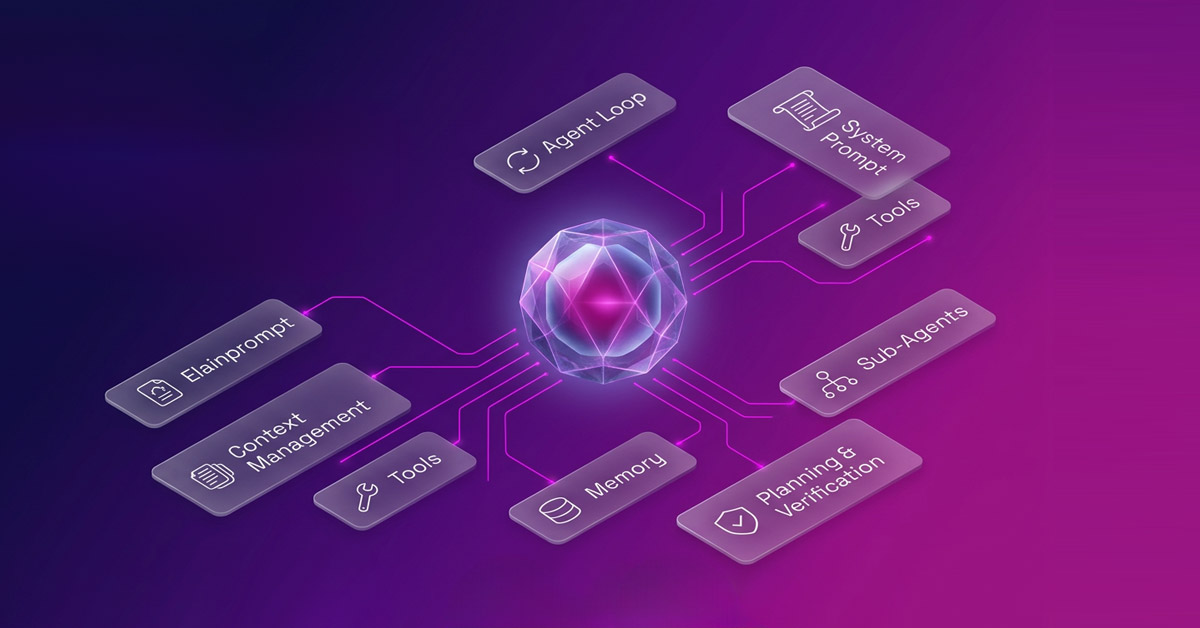
Most agentic harnesses rely on three essential components: tools, memory, and the agentic loop.
1. Tools: Giving AI the Ability to Take Action
Tools allow an AI model to do more than generate responses.
Depending on the environment, an agent can use tools to read and modify files, execute code, search the internet, interact with databases, or operate applications.
For example, a coding agent might inspect a project, identify a bug, modify the relevant files, and run tests to check whether the changes work.
Some tools are built directly into the harness. Others are accessed through a command-line interface, allowing the agent to use software already installed on the machine.
External services can also be connected through standards such as Model Context Protocol (MCP), which provides a common way for AI applications to access compatible tools and data sources.
The important point is that tools turn a model’s proposed actions into actual operations, within the permissions and restrictions of its environment.
2. Memory: Keeping Track of Information
AI models work within a context window, which limits how much information they can process at once.
Without additional memory mechanisms, information from previous sessions may not be available when a new session begins.
An agentic harness helps manage this limitation in several ways.
Persistent instructions: Project files such as AGENTS.md can provide coding conventions, architectural guidance, and other instructions that the agent can reuse across sessions.
Context compaction: When a conversation or task becomes too long, the harness can summarize earlier information while removing unnecessary details. This helps preserve important context without exceeding the model’s limits.
Information retrieval: Instead of loading an entire codebase or document collection into the context window, the harness can search for relevant information and retrieve only what’s needed.
These mechanisms help agents maintain continuity, work with large projects, and avoid repeatedly processing the same information.
3. The Agentic Loop: From Reasoning to Execution
The agentic loop is what allows an AI agent to work through a task over multiple steps rather than producing a single response.
The process usually follows a simple cycle:
- Plan: The model determines the next action needed to achieve the goal.
- Act: The harness executes the requested action using an available tool.
- Observe: The result is returned to the model.
- Repeat: The model evaluates the result and decides what to do next.
This cycle continues until the task is completed, the agent encounters a limitation, or execution is stopped.
For example, when fixing a software bug, an agent might inspect the code, make a change, run tests, review an error, and revise its implementation.
Some tasks require only a few steps. Others involve many iterations.
Why Verification Matters
A reliable agent shouldn’t simply make changes and assume they work.
Modern agentic harnesses can incorporate verification throughout the execution process. This might include running automated tests, checking application screenshots, validating outputs, or asking another model to review the work.
Verification helps identify mistakes earlier and reduces the risk of errors accumulating during longer tasks.
It doesn’t guarantee that an agent will always produce correct results, but it makes the process more reliable.
Why the Difference Matters
When comparing AI products, it’s easy to focus entirely on which model they use.
Model quality matters, but it doesn’t tell the whole story.
Two products using the same model can deliver very different results because their harnesses provide different tools, memory systems, execution strategies, and verification processes.
This is particularly important in software development, research, data analysis, and business automation, where completing a task often requires interacting with external systems rather than simply answering questions.
Improvements in AI capabilities don’t come exclusively from developing more powerful models. Better tool integration, context management, and execution workflows also play a significant role.
The distinction between models and harnesses is also evolving. Some capabilities that were previously managed mainly by external systems, such as planning and self-checking, are increasingly being developed within models themselves.
Even so, the surrounding infrastructure remains essential for translating those capabilities into useful actions.
Final Thoughts
An AI model provides the intelligence, while an agentic harness provides the infrastructure needed to put that intelligence to work.
Tools allow the agent to interact with its environment. Memory helps it retain and retrieve relevant information. The agentic loop allows it to plan, act, evaluate results, and continue working toward a goal.
Together, these components make it possible to build AI agents that can handle complex, multi-step tasks.
So, when evaluating an AI agent, don’t just ask which model it uses. Also consider what tools it can access, how it manages information, and how it verifies its work.
A powerful model matters, but how that model is put to work can matter just as much.