

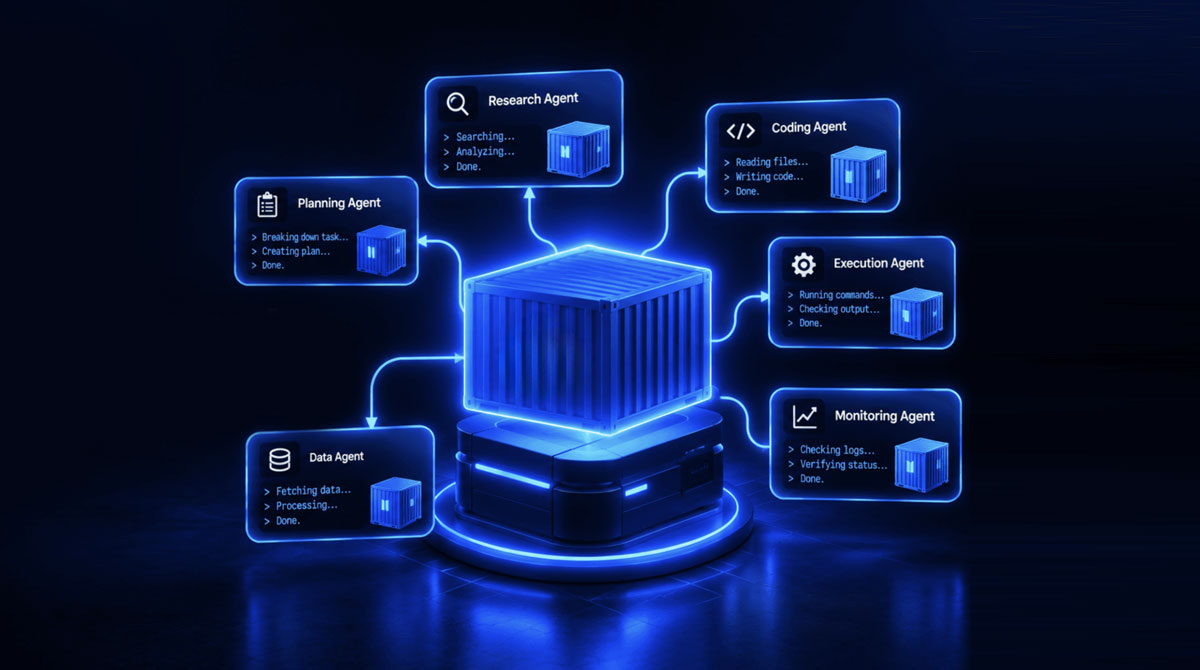
AI agents are changing what it means to work with artificial intelligence. A few years ago, prompt engineering was largely about writing effective instructions to get better responses from language models. Today, building AI agents requires much more.
An AI agent doesn’t just answer questions. It can interact with APIs, retrieve information, update databases, automate workflows, and make decisions that affect real users.
The challenge is no longer just getting an AI model to respond correctly. It’s building a system that works reliably, securely, and consistently in real-world situations.
That’s where agent engineering comes in.
Here are seven essential skills you need to build AI agents that go beyond impressive demos and actually work in production.
1. System Design
An AI agent is more than a language model. It’s a system made up of different components working together.
These might include an LLM for decision-making, external tools for performing actions, databases for storing information, and other agents for handling specialized tasks.
System design is about understanding how these components communicate, how information flows between them, and what happens when something goes wrong.
A well-designed agent needs a clear architecture, predictable workflows, and proper error handling.
Why it matters: Without good system design, even the smartest AI model can become part of an unreliable and difficult-to-maintain application.
2. Tool and API Contract Design
AI agents interact with external systems through tools and APIs. Each tool needs a clear definition of what it does, what inputs it accepts, and what outputs it returns.
For example, imagine an agent that retrieves customer information. If a tool simply accepts a generic string as a customer ID, the model might provide an invalid value.
A better approach is to define a strict schema with required fields, accepted formats, validation rules, and clear descriptions.
The goal is to reduce ambiguity and make tool interactions predictable.
Why it matters: Clear tool contracts reduce errors, improve reliability, and prevent agents from making incorrect assumptions when performing actions.
3. Retrieval Engineering (RAG)
AI models don’t always have access to the information they need. That’s why many production agents use Retrieval-Augmented Generation (RAG).
RAG allows an agent to retrieve relevant information from documents, databases, or knowledge bases before generating a response.
But simply connecting a vector database to an LLM isn’t enough.
Good retrieval engineering requires understanding:
- Document chunking: Splitting information into useful, meaningful sections.
- Embeddings: Representing text so relevant information can be found through semantic similarity.
- Search strategies: Combining approaches such as keyword and semantic search.
- Re-ranking: Improving search results by prioritizing the most relevant information.
The quality of retrieved information directly affects the quality of the agent’s responses.
Why it matters: Even a powerful AI model will struggle if it’s working with incomplete, irrelevant, or outdated information.
4. Reliability Engineering
AI agents depend on external services, APIs, databases, and network connections. Any of these components can fail.
An API might time out. A database might become temporarily unavailable. A service might return an unexpected response.
A production-ready agent needs to handle these situations without breaking the entire workflow.
Important reliability techniques include:
- Retries with exponential backoff to recover from temporary failures.
- Timeouts to prevent requests from hanging indefinitely.
- Fallback mechanisms to provide alternative paths when a service fails.
- Circuit breakers to prevent repeated failures from affecting the entire system.
- Idempotency controls to avoid accidentally repeating actions such as payments or refunds.
These are established software engineering practices, but they’re just as important when building AI agents.
Why it matters: A reliable agent should recover gracefully from failures instead of getting stuck, repeating actions, or crashing.
5. Security and Safety
AI agents introduce new security challenges because they can access data and perform actions on behalf of users.
One major risk is prompt injection, where malicious instructions are placed in content the agent processes, such as documents, websites, emails, or user messages.
An attacker might try to trick an agent into revealing private information or performing unauthorized actions.
Protecting agents requires more than carefully written system prompts.
Developers need proper input validation, access controls, permission boundaries, secure tool execution, and human approval for sensitive actions.
An agent that only needs to read customer information, for example, shouldn’t automatically have permission to modify or delete it.
Why it matters: The more autonomy an agent has, the more important it becomes to control what it can access and what actions it’s allowed to perform.
6. Evaluation and Observability
Building an AI agent is only the beginning. Understanding how it performs in real situations is equally important.
When something goes wrong, you need to know what happened.
Did the agent retrieve the wrong document? Did it select an incorrect tool? Did an API return an error? Did the model misunderstand the user’s request?
This is where observability comes in.
Tracing and structured logging help developers understand the sequence of actions an agent takes, including tool calls, retrieved context, errors, and execution times.
Evaluation adds another layer by measuring how well the agent performs against defined test cases and expected outcomes.
Useful metrics include task success rate, response accuracy, latency, error rate, and cost per task.
Why it matters: You can’t reliably improve an agent without understanding where it fails and measuring whether changes actually make it better.
7. Product Thinking and User Experience
An AI agent can be technically impressive and still provide a poor user experience.
People need to understand what an agent can do, what its limitations are, and when they should trust its results.
Good agent design considers questions such as:
- When should the agent ask for clarification?
- When should it request approval before taking action?
- How should it communicate uncertainty?
- What happens when it cannot complete a task?
- When should it hand control back to a human?
These decisions shape how users interact with the system.
For example, an agent processing refunds should clearly explain what it’s doing and confirm important actions rather than silently making decisions.
Why it matters: Successful agents aren’t just technically capable. They’re also understandable, predictable, and trustworthy.
How to Start Developing These Skills
You don’t need to master all seven areas before building useful AI agents.
The best approach is to start with an existing project and improve it step by step.
First, review your tool definitions. Make sure every tool has a clear purpose, properly defined inputs and outputs, and appropriate validation. Remove ambiguity wherever possible.
Next, investigate one recurring failure. Instead of immediately changing the prompt, examine the complete workflow. Look at the retrieved context, tool selection, API responses, and error handling.
You might discover that the problem isn’t the prompt at all. It could be poor retrieval, an unclear tool description, missing validation, or a failure in the application architecture.
Fixing these underlying issues often produces more reliable improvements than repeatedly rewriting instructions.
As you gain experience, introduce automated evaluations, observability tools, security controls, and better user interaction patterns.
Final Thoughts
Prompt engineering is still valuable, but it’s only one part of building effective AI agents.
The shift from prompt engineering to agent engineering is really a shift from optimizing individual AI responses to designing complete, reliable systems.
System design provides structure. Tool contracts make interactions predictable. Retrieval engineering delivers the right information. Reliability engineering handles failures. Security protects users and data. Evaluation makes improvement measurable. Product thinking makes the agent useful and trustworthy.
You don’t need to become an expert in every discipline overnight. But understanding how these areas work together is essential.
The future of AI development isn’t just about writing better prompts. It’s about building better systems around AI.